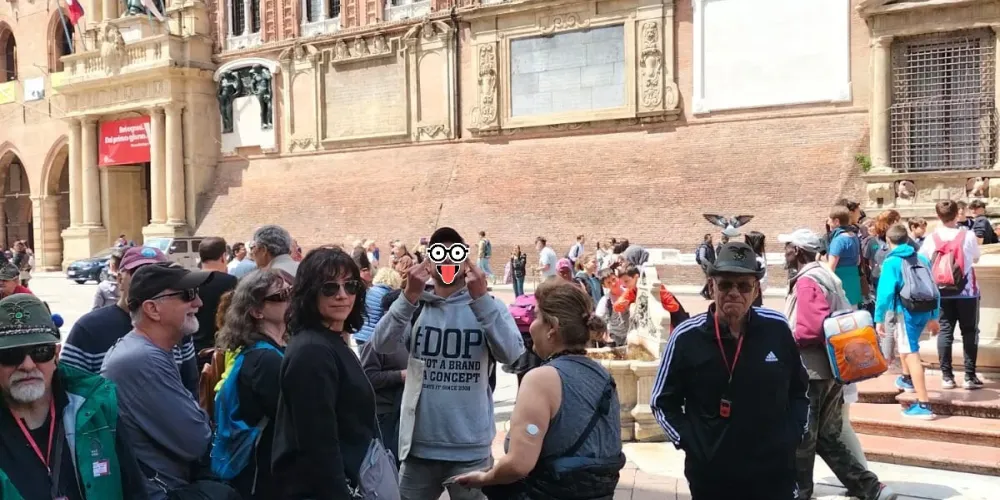
In Bologna we got a problem, and it’s not the unregulated tour activity
A few weeks ago, we received notice from the Metropolitan City of Bologna about the launch of an awareness campaign against illegal guiding, titled “STOP Illegal Guides” The initiative is promoted by Confguide, Confcommercio Ascom Bologna, and supported by the Municipality, Bologna-Modena Tourist Territory, TPER, and Bologna Welcome.
The campaign claims the ambitious goal of informing tourists about the consequences of an ill-advised choice: hiring unlicensed individuals to lead city tours. This would be done through the printing of 500 flyers and the installation of information points across the city. Around the same time, headlines were made when a retired teacher in Bergamo was fined for accompanying a group of people from an association on a tour of the city – despite not holding the proper qualifications. While illegal guiding is a serious issue that harms both professionals and tourists and should be addressed accordingly, we must also acknowledge that such limited campaigns are unlikely to have any real effect.
Let’s be clear: the issue is not the retired teacher – who has our full support. The Bologna initiative, in fact, omits several key details that would help us better understand a much more complex problem. Let’s take a step back.
Many may not know that in Italy, to lead guided tours one must hold official certification, obtained by passing an exam and receiving a license as a tourist guide and/or tour leader. Let’s set aside the longstanding debate about the difference between these two roles, and focus on the former. As of today, there is no national law clearly regulating the profession. Instead, the responsibility falls to the regional governments, resulting in a confusing patchwork of legislation that complicates rather than simplifies the situation.
Navigating this maze of regulations is difficult. Many either get lost in it or, more often, simply sidestep it.
In recent years, with the tourism boom in many Italian cities – Bologna being a prime example – the demand for tourist services has surged, while the supply has diversified. The traditional circuits have failed to meet this demand, due to shortsightedness, lack of vision and capacity, or simply because the numbers were overwhelming. As a result, a shadow market has emerged, made up of individuals with varying degrees of qualification, who have stepped in to fill the gap.
After the Covid-induced “pause” – which further exposed the sector’s weaknesses – tourism numbers this year are expected to return to or even exceed 2019 levels. Bologna, like many other cities, is completely unprepared, with a fragmented and quantity-driven reception system. Many accommodations closed during the pandemic never reopened, and many professionals have moved on to more stable sectors.
Illegal guiding is nothing new – it has always existed across the tourism industry and has, at times, been tolerated or even tacitly supported by institutions when convenient. Yet, we’re told that 3,500 jobs have been lost due to illegal guides (Ascom Bologna data), while very few unlicensed guides are ever officially reported. Is it that we don’t know where to look? Or is the problem exaggerated?
As usual, the truth lies somewhere in between. There are numerous platforms, mostly international, that offer tours led by individuals who are not always certified to do so: Guruwalk, Freetour, and even Airbnb are just a few. And it’s not hard to verify – names, times, and meeting points are publicly listed. Yet we see statements rather than action.
The campaign also fails to mention a crucial fact: the person “taking work away” from licensed guides – the so-called illegal guide – may not have skipped the exam. They may simply have never had the opportunity to take it – because the exam no longer exists. That’s right: in Emilia-Romagna, courses and licensing exams for tourist guides have not been held since 2016. Today, anyone wishing to become a certified guide simply cannot, unless they go abroad – and indeed, some have traveled to Romania just to obtain the title.
Thus, the very system meant to protect the profession – the licensing exam – ends up doing the opposite: it creates the perfect environment for illegal guiding to thrive. The problem is not a lack of work – quite the contrary. The problem is a shortage of qualified guides.
A glance at the provincial registers reveals the gap: among hundreds of listed names, less than half are actively working – many do so occasionally, and most are in late adulthood or older. Since the introduction of licensing, there has been no generational turnover.
We need a new culture of hospitality.